
1 John 2
Introduction: Today I step into Chapter 2 of 1st John.
There are a couple of subjects of significance in this chapter, and I won’t cover them all completely.
2:1 – If (when) we sin, we have an advocate who pleads our case before the Father.
Advocate = parakletos – one summoned or called to one’s side, who pleads another’s case before a pleader. A ‘defence attorney’ of sorts).
2:7-14 – A New Commandment
- Not a new commandment, rather it is an old one; from the very beginning.
- 1 John 2:7
- It may therefore be called the OLD commandment, which was from the beginning; and also a NEW commandment revealed afresh and illustrated by Christ,
- Instead of adelphoi, brethren, ABC, thirteen others, with both the Syriac, Erpen’s Arabic, Coptic, Sahidic, Armenian, Slavonic, and Vulgate, with several of the fathers, have
Agapeetoi, beloved. This is without doubt the true reading.
2:8, again John reminds, ‘because the darkness is passingand the true lightis already shining’. (NIV)
2:9, ‘If anyone claims’ (again uses this term)
claims = to say, speak, affirm, or maintain.
‘I am living in the light’.
‘But hates a Christian brother or sister’. = 1 John 2:9
- He that professes to be a convert to Christianity, even in the lowest degree; and hates his brother-not only does not love him, but wills and does him evil, as the Jews did the Gentiles;
- ‘Is still in darkness’-has received no saving knowledge of the truth; and, whatever he may pretend, is in pagan ignorance, or even worse than pagan ignorance, to the present time, notwithstanding the clear shining of the light of the Gospel.
- ‘has been blinded by the darkness’
Question: is there a real difference between un-liking someone and hating them?
Yes, there’s a real difference between liking someone and hating them, though the boundary between them can sometimes be blurry. While both involve strong feelings directed towards another person, they differ in intensity, motivation, and overall impact.
Here’s a more detailed breakdown:
Intensity and Depth:
Hate is often a more intense and persistent emotion than mere dislike.
- Hate – It usually involve feelings of intense anger, resentment, and a desire to see the other person suffer.
- Liking, while positive, is generally less intense and more about appreciation for someone’s personality or character.
Transition: I now want to focus on one of the first things I was taught to respect and follow as a new believer.
2:15, ‘Do not love the world or the things in the world. If anyone loves the world, the love of the Father is not in him’. (NKJ)
Question: What does this mean and how do we differentiate?
Can I not ‘love’ the Dodgers or a great steak?
Answer: In the Bible, the term world can refer to the earth and physical universe (Hebrews 1:2; John 13:1), but it most often refers to the humanistic system that is at odds with God (Matthew 18:7; John 15:19; 1 John 4:5).
- When we are told not to love the world, the Bible is referring to the world’s corrupt value system.
- Satan is the god of this world, and he has his own value system contrary to God’s (2 Corinthians 4:4).
Application: The world often applauds sin. Hollywood encourages us to envy sinners and to foolishly compare ourselves with it/them.
Loving the world means being devoted to the world’s treasures, philosophies, and priorities.
God tells His children to set their priorities according to His eternal value system. We are to “seek first” God’s kingdom and righteousness (Matthew 6:33).
No one can serve two masters (Matthew 6:24), and we cannot be devoted to both God and the world at the same time.
Transition: First John 2:16 details exactly what Satan’s system promotes: the lust of the flesh, the lust of the eyes, and the boastful pride of life. Every sin imaginable can be summed up in those three evils.
- Lust of the flesh
- Most often the Bible uses the word flesh to refer to the propensity to sin we possess in our earthly existence. Our sinful nature, dominated by sin and rebellion, is so closely tied to the physical aspect of mankind that it is called “the flesh.”
- Desires that arise from the fact that we are earth-bound, fleshly creatures are not sins in themselves.
Application: We desire food, water, shelter, sex, and comfort. God created us with those desires.
- However, we are born sinful, desiring to please ourselves, regardless of God’s moral law (Romans 3:10, 12). When fleshly desires rule us, taking priority over God’s will, they cause us to violate God’s righteousness.
- Lust of the eyes
- Simply put, the lust of the eyes is the sinful desire to possess what we see or to have those things which have visual appeal.
Application: This coveting of money, possessions, or other physical things is not from God, but from the world around us.
- John emphasizes that these physical things do not last; they will pass away.
- Pride of Life
The phrase “pride of life” is found only once in the Bible, in 1 John 2:16, but the concept of the pride of life, especially as it is linked with the “lust of the eyes” and the “lust of the flesh,” appears in two more significant passages of Scripture.
- the temptation of Eve in the Garden
- Genesis 3:6
Eve perceived that the fruit was “good for food,” “pleasing to the eye,” and “desirable for gaining wisdom”
- the temptation of Christ in the wilderness (Matthew 4:8-10).
- The pride of life can be defined as anything that is “of the world,” meaning anything that leads to arrogance, ostentation, pride in self, presumption, and boasting.
Application: Christians have always been, and will always be, lured by the same three temptations Eve and Jesus experienced.
- Satan doesn’t change his methods; he doesn’t have to because they continue to be successful.
- He tempts us with the lust of the flesh—sexual gratification, gluttony, excessive alcohol consumption, and drugs, both legal and illegal, as well as the “deeds of the flesh” about which Paul warned the Galatians, “sexual immorality, impurity, sensuality, idolatry, sorcery, enmity, strife, jealousy, fits of anger, rivalries, dissensions, divisions, envy, drunkenness, orgies, and things like these” (Galatians 5:19-21).
- He tempts us with the lust of the eyes—the endless accumulation of “stuff.”
Application: We fill our homes and garages and the insatiable desire for more, better, and newer possessions, which ensnares us and hardens our hearts to the things of God.

More Than Enough
OPENING: When what we have seems small John 6:1–13 Church, most of us know what it feels like to look at a need and wonder how we are going to meet it. We look at the bill, then at the balance. We look at the responsibility, then at the strength we have left. Sometimes the…
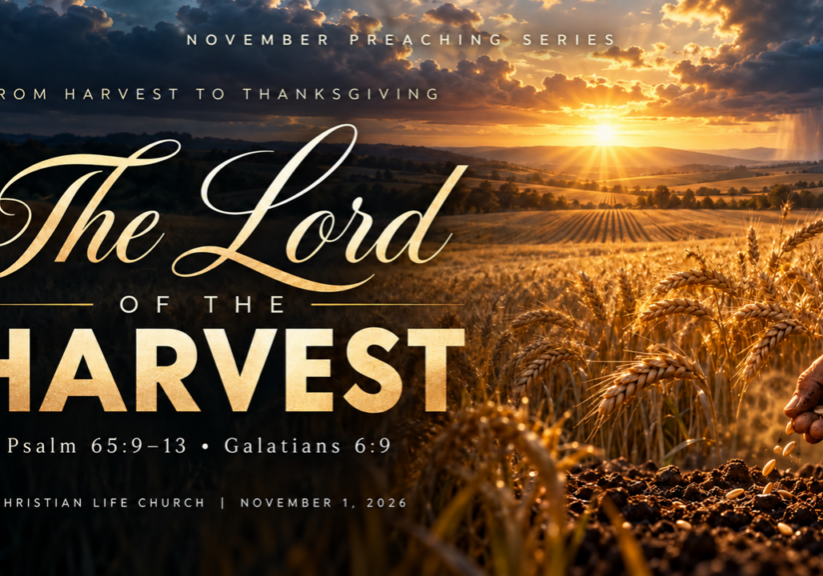
The Lord of the Harvest
This morning I/we begin a November journey called “From Harvest to Thanksgiving.” During these Sundays we will think about what God provides, how He blesses us, how we remember His faithfulness, and how gratitude becomes a way of life. We begin with the source of every harvest: the Lord Himself. SCRIPTURE “You crown the year…
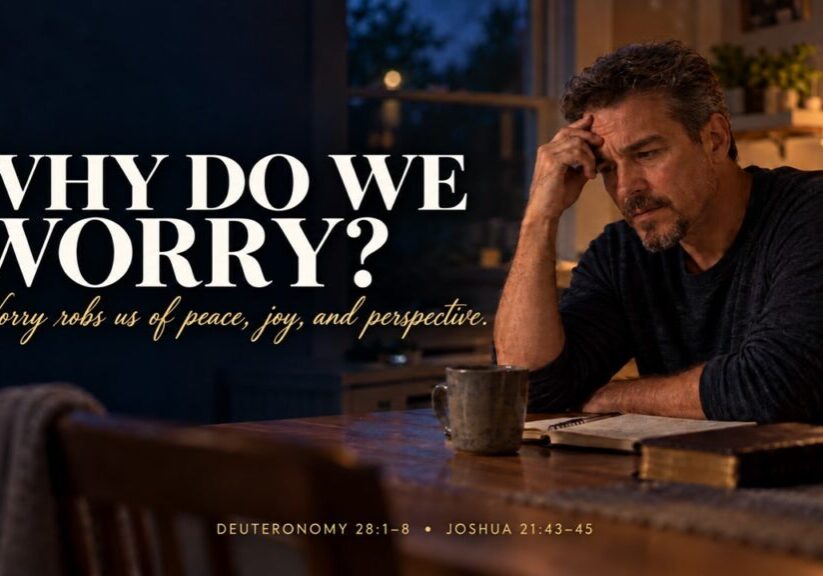
Why Worry?
Recognize what worry does to us – Matthew 6:25–34 We can live the same difficult moment again and again in our minds. We imagine the phone call, the appointment, the conversation, the bill, the test result. We are physically here, but in our thoughts we have already traveled into the future and suffered through outcomes…

Choices
A SERMON FROM THE LAST THREE CHAPTERS OF JOSHUA GRACE WARNING CHOICE CHOICES A 30-MINUTE SERMON KEY SCRIPTURE “Choose for yourselves this day whom you will serve… But as for me and my house, we will serve the LORD.” — Joshua 24:15 NKJV BIG IDEA Our choices shape our direction, develop our character, and influence…

Strong and Courageous
Joshua 1:1–9 | Pastor Mike Hinojosa “Be strong and of good courage; do not be afraid, nor be dismayed, for the LORD your God is with you wherever you go.” —Joshua 1:9 NKJV Moses had died. Joshua faced a new responsibility, an uncertain future, and a river to cross. God called him to move forward…

the Heart of Genuine Revival
🔥 THE HEART OF GENUINE REVIVALWhen God Awakens His People “Will You not revive us again, that Your people may rejoice in You?”— Psalm 85:6 NKJV Revival is God breathing fresh life into hearts that belong to Him but desperately need to awaken again. Genuine revival begins in the heart, spreads through the church, and…


The Great Conclusion
THE GREAT CONCLUSION ALL THINGS NEW REVELATION 20:7–22:5 “Behold, I make all things new.” REVELATION 21:5 WHERE BIBLE PROPHECY FINALLY TAKES US • Satan defeated • Final judgment completed • Death ended • The curse removed • God dwelling with His people forever THE END OF PROPHECY IS NOT DESTRUCTION. IT IS RESTORATION. INTRO. WE…

The Millennial Reign
THE MILLENNIAL REIGN THE KING • THE KINGDOM • OUR LEGACY Revelation 20:1–10 BIG IDEA Jesus is not only coming back to rescue His people. He is coming back to reign as King. THE GREATEST LEGACY WE CAN LEAVE IS A LIFE THAT WAS FAITHFUL TO THE KING. INTRODUCTION — WE HAVE NEVER SEEN A…